Showing posts with label education. Show all posts

Tuesday, September 2, 2014

Where Does My African-American Child See Herself in Books?

Over the weekend, I went to the National Book Festival with two of my daughters. Elle, a high schooler, is the voracious reader of the family.  Often times, before any of the rest of us can finish reading – or even begin to read – a book that we’ve checked out of the library or bought at the bookstore, she has “borrowed” and finished the book, then handed it back with a quick review.  No book is safe in her arm’s reach (and she has long arms.)  Nat came along, too; still in elementary school, she reads when and if she feels like it.


We came away from the day with two children/teen books.  One was Zero Degree Zombie Zone, a fun, adventure story about an African-American boy and his friends, written by Patrik Henry Bass and illustrated by Jerry Craft.  Since African-American boy adventure books are hard to find, I even willingly paid the hardback price for a copy for my son.  The other book was Sisters by Raina Telgemeier; a graphic novel about the trials and quibbles of sisterly love. The line drawing characters are presumably not African-American, but no matter; Nat connects to the sisters, plus really likes this author’s previous novel, Smile.


What did Elle get? Nothing. My reader child, the one who was anticipating the Book Festival, came away empty handed.  Although, she did read the zombie book on the Metro ride home before handing it over to her brother.  But for her – my African-American, teen girl, who does not like vampires, witches, demons, and spooky stuff, but does like some sci-fi, adventure, and a little teen angst drama – nothing.  And she came away with the conclusion, as she often does when we attend big book events, that there are no books about teenage Black girls.  She can and does read plenty of books about White teens who travel through time, run from crazy parents, fight against scientific experiments, chase and are being chased by other kids, fall apart from their best friends, and fall in love. But kids who look like her? Not so much.

So where are the books for and about Black teens? Ones where they are not the minor character or the jovial sidekick friend.  When does the Black boy get to be the hero of the story for his own strength, not the illiterate downtrodden athlete that will be saved by the loving White family?  When does the Black girl get to be the heroine who shoots the bow and arrow and gets the boy, instead of the runaway slave?  How long before the Black girl meets the great guy and goes on a once-in-a-lifetime vacation before he dies and we all cry uncontrollably over their teen love?

Do a quick search of the top teen books, even Young Adult, as the line seems to blur sometimes.  Go to Barnes and Noble or Amazon, and take a look. Aside from most of the books being about a dystopian society (a popular theme, apparently in teen books) you may notice that all the people on the cover of the books are White.  Even the vampire and ghost children.  I recently read a list of the “20 most anticipated” books for young adults.  A quick tally showed that of the 20 books:
  • There were no Black main characters (based on description, cover photo, and/or assumption based on the author’s race)
  • There were two Asian characters (the author/co-author of both books were also Asian)
  • Thirteen were about someone who has died, is dying, or will die.  More than thirteen people, however, will die in these books as a few were about the dying of multiple and many people.  Happy reading.

I do have some concern that so many of the current books for teens and young adults are about kids trying to kill other kids or scary, demonic beings trying to kill kids, but that’s a whole ‘nother book discussion for another day. For now, let’s get back to the lack of Black characters.

Why does it matter?  As an illustration, let me pose this activity. Think of a classic or contemporary teen book. Let’s say, Charlotte’s Web.  Would it have been a different story if Fern was African-American?  (Feel free to also imagine Fern as any other race, not often found in American teen fiction, such as Asian and Latino.) Wilbur would still have been destined as bacon, Charlotte would still spin words in her web, and they all would still make the journey to the fair. But perhaps it would’ve attracted the attention of a Black child, perhaps it would’ve spurred a love of reading in a little Black girl to see herself as Fern and remember her grandparents’ farm in North Carolina.  Like The Wiz as the African-American version of The Wizard of Oz, there perhaps would’ve been a different spin on the story.  A different child would see people who look like her.

And that’s what diversity in children’s and young people’s books is about. Stories that allow our young people to imagine themselves as the heroes, as the crusaders, as the girl who meets the boy, as the boy who stands up to bullies, as the kid who survives middle school, as the regular ole kid who somehow makes it past all the hurdles of the teen-years and makes it to adulthood.

So I encourage the writers who want to write these stories – write.  That’s how I finally came to write my first novel (an adult novel, not for teens) because, paraphrasing Toni Morrison, we have to write the stories we want to read.  And let’s support those authors who write (good) books about diverse characters.

Final question. Does it matter that there are African-American characters, as well as Asian and Latino?  Answer this first – would it matter if there were no White characters?


Join the conversation on Facebook: Just Piddlin' with Frances

Tuesday, July 8, 2014

Are You Involved at Your Child's School?

I recently participated in a focus group about school-parent communication.  It was an interesting discussion, with participants that ranged from parents, like me, teachers, and school administrators.  I’m a strong advocate for parents being involved in their children’s schools and being an important part of the education process.

To expand the range of answers, I’d like to pose a few questions to you, my readers.  Please take a moment and reply in the comments to one or both of the following questions.
  • What does it take to motivate you to advocate or take action on an educational issue (local, state, and/or national)?
  • How would you improve communication channels between parents and teachers/administrators at your child’s school? 
Thank you!

Join the conversation on Facebook: Just Piddlin' with Frances

Thursday, October 3, 2013

Who knew this would be a job? Blogging at Blogalicious

Hey y'all! I'm down in my old neighborhood - Atlanta, Georgia! Hubby and I lived here for a bit after we finished getting educated.  I'm here for the Blogalicious! Conference - a social media collaboration for multicultural bloggers.  
 

Being here is so far from where I even imagined when I first claimed "slackermomof4.blogspot.com" as my online space. Let me tell you how much blogging was a passing experiment for me when I started - I went to Korea for a week and didn't even post! What? Yes. Not a tweet, nothing. I think there might've been a Facebook post?  So here I am, enjoying some delicious biscuits and butter at a conference to learn how to make this digital spot a better experience for the both of us, you & me.
 
There's a lot of tech-y stuff being talked about. SEOs and mobile capabilities and analytics and such, much of which I will have to have hubby decipher and re-explain to me when I get home (or one of the kids) so I won't bore you with all that.  But I did want to share with you something I've realized with much more clarity while here, just in one day.
 
(Pausing to taste this shrimp & grits.)
For all we stress about over what our kids are learning or not learning, whether they are in a magnet program or academy or whatever special program - and, I'm including myself in that stressed out parent group - the important thing is that our kids not only learn at a challenging level, but that they learn to learn and to be flexible.  We don't know what they will be when they grow up, because we don't even know what there will be to be when they grow up.
 
A hundred years ago, folks were farmers and planned for their kids to be farmers.  And they grew up to be farmers. Some time after that, folks did the same in being assembly workers.  Then somewhere in the recent past, folks were typewriter repairmen and their kids studied typesetting and they became computer programmers.
 
Today, one of the presenters was the social media manager for Kerry Washington. Her job, among other things, is to watch TV, know what Olivia Pope is wearing and be ready to answer Scandal-ous tweets.  And  maybe, I'm guessing,  say "hey!" to Columbus Short every now and then.  I'm guessing.  That is what the woman gets paid to do. Her college major? International business. You see the connection? Right, exactly. She moved from one job to the next, learning as she went and parlaying that and the network she built into the next move.
 
Harriette Cole is here. Did you get married in the 90's? Perhaps you used her book, Jumping the Broom, to plan your wedding. I did. She used to be an editor at a magazine. She now, also among other things, has a crocheted clothing business. See the connection? Now you see what I'm saying?  They've changed, they've adapted, they've learned.
 
Closer to home, my daughter is taking a photography class in high school. I did, too. Do you need a camera, is the class fee for chemicals, you shouldn't wear your best clothes on film developing day, I said when school started. Her response: I have a phone, the fee is for paper, what film?
 
Everything's constantly changing. For our kids to be successful whatever's when they grow up, it's not important that they learn today's technology and lingo and market forever and ever. But they do need to learn it to understand their current world and learn how to learn about the world as it changes tomorrow.
 
As for me? I'm going to finish this peach vodka cocktail (hey, it's Georgia!), go peek at these crocheted creations and then go tweet about this season's white suit. And  her you-know-who in the back of the car! 


Tuesday, June 18, 2013

Summer Academics

Parents, you've heard it a million times - keep the kids working and learning over the summer.  Don't let their brains become so filled with lemonade that they have forgotten how to conjugate a verb or add an equation by the time the get back to school.  They have their summer packets from school, but I've learned from past summers that for the little ones, they can get these done in a concentrated effort of 2, maybe 3 days.  What about the other 70-some days?

Math. You remember math - geometry, algebra, trig. Or more to the point, maybe you don't.  And until the kids know 7x8 as well as they know their favorite ice cream flavor, they need to keep practicing.  What math skills are studied over the summer, obviously, depend on the level of math your child is in at school. Perhaps, they had a tough year and they need to reinforce what they learned in order to be ready for the next level.  Or, they may have had a good math year and are confident in their arithmetic skills.  I supply my kids with a stack of math workbooks for the summer, trying to span a little reinforcement from the previous year and a challenge of looking forward to next year's math.  This year, I've got Singapore Math for the word problems and Kumon for the basic skills (ex. how to multiply fractions).
Math work for every grade
Our schools are going with the Common Core Standards curriculum; I noticed at the bookstore some books are stamped with a "Common Core aligned" emblem. I didn't check all the details, but from my understanding of this new curriculum, the main point is to push the kids to think in a wider range than "15 + 10 = ?" and develop a greater range of thinking and problem solving skills.  Thus, I have a word problem set for each of the kids - 3rd grade, 5th grade, and Algebra-based.

Reading.  We put our library cards into overdrive for the summer.  I encourage them to read a book a week - a mere 8 books over the summer!  Elle also has required reading for 9th grade, with related written work, so that of course is her priority, but she's the reader and will get a bunch of leisure reading done, too.  Our library has a book challenge, when the kids have read a certain number of books, they get a prize. Barnes & Noble offers one, too.

Make up your own house reading challenge - number of books for the younger set, number of pages for the older folks.  I'm not big on elaborate prizes, but do consider one, I mean, what's a challenge without a prize. Perhaps a book gift card, getting to pick out cupcakes when the challenge is met, or an outing to somewhere fun.

Check my post specifically on reading for more tips on getting thru the summer books.
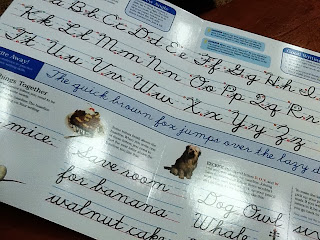
Learning cursive is on the summer agenda
 Writing. What the kids write isn't as important to me as the fact that they do. Grab one of those notebooks from the school year (if like my kids, most are half-full) and have them write each day during the summer break.  Just one page. Whatever they want. They'll get practice in thinking, writing, spelling in a non-pressure environment.  And they'll get handwriting practice which leads me to the next item.

Cursive.  Perhaps its the new curriculum, but my little ones don't get cursive in school.  J is going into 5th grade and only writes in print. I know the arguments: "no room in the curriculum," "everybody types anyway," "at least they can print."  Yeah, heard it all. But what happens when they are given something in cursive and then have to say, "I can't read this"?  What happens when they have to actually sign their name on something?  What happens when they become grown people and want to write in something other than their elementary print?  Cursive writing is on the list for the summer.  (BTW - I printed letter guides from www.handwritingforkids.com.)

All this, and yes, we will still manage to get to the pool and basketball games and tennis practice and the  zoo and the park and make ice cream and cook dinner and have a picnic and lounge around and do nothing.  It is summer, after all.

Tuesday, December 11, 2012

She got an A+? I need to see the teacher

"Mommy, guess what!  I got an A+ on my project!"
"The project you took out of here this morning?" I thought.  "Impossible."  
"You did, huh?" I said out loud.  "Did you make any changes to it before you turned it in?"
"Nope, turned it in just like it was.  And I got an A+ on the presentation, too." She smiled, then skipped off to her room. 
I turned to my computer, pulled up my email, and sent an email to the Principal that in short said "we need to talk."
Our expectations of our children need to be higher.
 
Different response than you would expect?  My daughters feel the same way when I insist on going to the parent/teacher conferences.  "You know I got an A in math, right?  Why are you going?" They ask.  

So why am I going to meet with the Principal about this last grade?  Because an 'A+' is supposed to indicate superior work, exceeding all expectations.  An 'A' is a sign of "90% or more was done as expected".  And 'A+' means the student went above 100% of what was asked.  My daughter's project had misspellings, grammar errors, and was not well researched.  If this is an 'A+', I'm concerned about her teacher's expectations. 
 
Now understand, I do believe my children are fully capable to do quality, top-grade work, and if any were to come home with something less than a B, they're going to have problems.  But an A should represent a good effort made to prepare a perfect specimen of work; a B, an effort that didn't exactly make the mark, but was a very good attempt.  An A should not be awarded to papers that are full of mistakes and obviously show a lack of effort; especially not an A+.
 
It's about more than the grade that will go on the children's report cards.  They are in middle and elementary school, so their grades (with the exception of a few classes) will never be seen by college admissions counselors or anyone else post-graduation.  They should be learning about setting their own standards, having high expectations for themselves and their work, and figuring out what it means to really do a good job.  In middle school, they should be expecting that they will have to do something over to get it right, wear through a little bit of pencil lead to get the answer, spend some time on a project, and learning to make corrections when they get something wrong. And maybe, I might be reaching her, but just maybe, it would be nice for them to open a book and write a paragraph.  I'm just saying, it might be nice.
 
The lesson my child has taken from her recent grade is that minimal effort, obvious mistakes, and pretty pictures will earn her an A+.  Yes, I need to see the Principal.